The DOHT Governance Structure
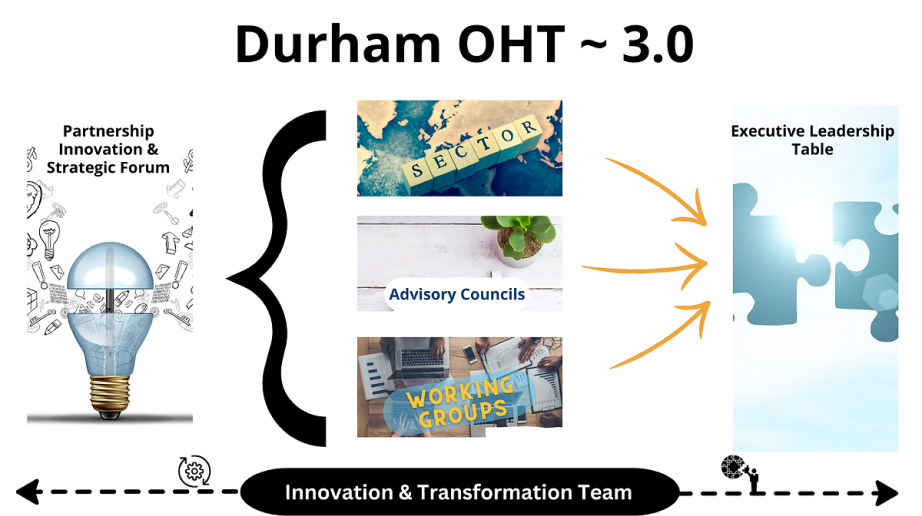
The Durham OHT has undergone much change since 2019, including three iterations of governance to support the residents of Durham Region.

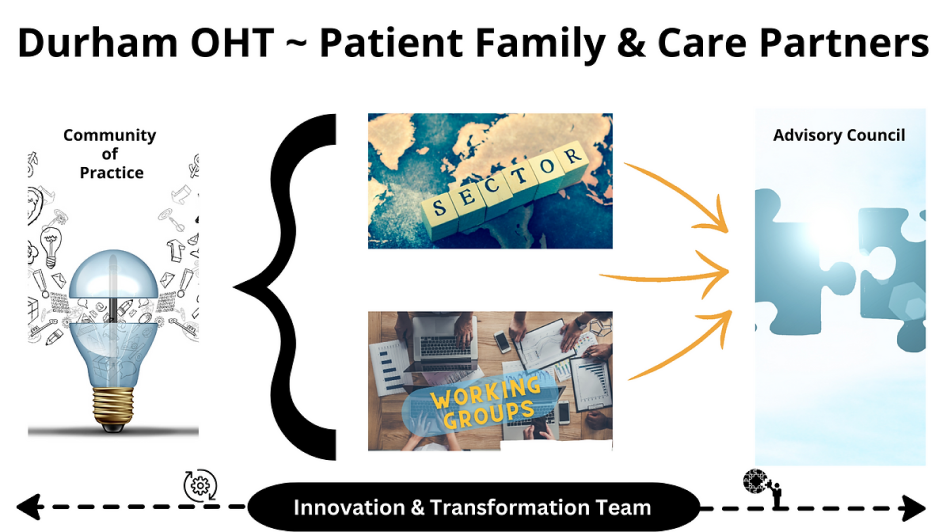
Committees and Working Groups
Executive Leadership Team (ELT)
The Durham Ontario Health Team Executive Leadership Table (ELT) develops and oversees the annual operational work plans. It reviews and approves decisions on cost and resource allocation, including funding for human resources, capital, and facilities. The ELT leads consultations with sector network tables and key stakeholders and provides executive support to the Strategic Implementation Lead
- Reviewing and approving decisions related to the allocation and sharing of costs and resources, including funding earmarked for the Durham OHT including but not limited to human resources, capital, facilities, and costs related to supporting the work of the Durham OHT;
- Leading formal and informal consultation activities with members of the Durham OHT Sector Network Tables, Collaboration Council and other relevant key stakeholder groups as part of the ELT’s review and approval process;
- Providing Executive Sponsor level support to the Durham OHT Strategic Implementation Lead;
Partnership, Innovation and Strategic Forum
A coalition of partners that is committed to a common set of principles and goals to improve health and wellness across Durham.
We are committed to achieving those goals through engagement and partnering with patients/clients, families, and care partners and each other.
Communications Working Group
Lead work focused on strengthening Durham OHT Partner Engagement and enhancing engagement with local communities to inform planning and build awareness of Durham OHT work.
Data Governance and Digital Health Committee
The mandate of the Durham OHT Digital Health and Data Governance Committee is to provide facilitation, coordination, and integration of the OHT and its partners’ digital health needs. In addition, the committee is responsible for overseeing the execution of the Harmonized Information Management Plan and setting priorities and direction in the Durham OHT’s digital health initiatives, data governance, and analytical capabilities. This includes:
- Facilitating collaboration among partner organizations to leverage digital solutions effectively.
- Coordinating efforts to align digital health initiatives with the overall vision and priorities of the Durham OHT and its partner organizations.
- Integrating digital health strategies that contribute to the advancement of regional and integrated care.
- Ensuring that the governance framework supports the ethical and secure use of digital health technologies.
- Providing oversight and guidance on digital health projects to enhance the overall effectiveness of the OHT.
- Ensuring information management initiatives align with overall organization goals.
- Legal requirements are met when information and data is shared among stakeholders.
- Standards of information protection and ethical practices are consistently observed on Durham OHT Projects, and
- A consistent and meaningful view of the data is provided to other Durham OHT working groups and committees.
Patient, Family and Care Partner Advisory Council
The Durham Ontario Health Team (Durham OHT) Regional Patient, Family and Care Partner Advisory Council (PFCPAC) will work in collaboration with Durham OHT partners to ensure that engagement, partnering and co-design with patients, families and care partners are embedded in all Durham OHT activities in order to improve the system of health and social care and support for Durham Region residents.
Performance and Evaluation Working Group
The Durham OHT Performance and Evaluation Committee is focused on supporting the translation of the system, and provincial-level goals related to performance measurement, quality and evaluation to our local Durham region context. This includes:
- Collaborating with both Durham Service provider organizations, supporting Quality and Performance networks (i.e. HSPN, RISE) and equivalent committees in other OHTs in the development of a larger system performance framework for OHT-Durham including but not limited to the identification of shared quality improvement objectives and the development of Collaborative Quality Improvement Plans (QIPs)
- Supporting the monitoring and evaluation of existing OHT-funded initiatives and the performance and evaluation frameworks of new initiatives to assist in ensuring progress in improving the quality of care for target OHT priority populations
- Providing oversight to quarterly performance data submissions to Ontario Health
Primary Care Leadership Council
The Durham Ontario Health Team (OHT) is comprised of partners representing the full continuum of care and includes patient/client, family, and care partner representation.
These partners range from health and social services to local municipalities and beyond, with an interest and commitment to designing and delivering an integrated health and social care system for residents of Durham region. Ensuring primary care is at the core of the OHT requires a dedicated primary care advisory council.
Ministry of Health
The Ontario government is building a connected health care system centered around patients, families and caregivers. These changes will strengthen local services, making it easier for patients to navigate the system and transition between providers.
Ontario Health Teams are being introduced to provide a new way of organizing and delivering care that is more connected to patients in their local communities. There are 54 Ontario Health Teams across the province that have been approved through a standardized intake and assessment process. The goal is to ensure that everyone in Ontario can benefit from better coordinated, more integrated care. At this time, the ministry is supporting the expansion of provider partnerships in existing Ontario Health Teams.
Under Ontario Health Teams, health care providers (including hospitals, doctors, and home and community care providers) work as one coordinated team – no matter where they provide care.
Providers and organizations eligible to become an Ontario Health Team include, but are not limited to, those that provide:
- Primary care (including inter-professional primary care and physicians)
- Acute care (such as in-patient and ambulatory medical and surgical services, including specialist services)
- Home care
- Community support services
- Mental health and addictions services
- Health promotion and disease prevention services
- Rehabilitation and complex care
- Palliative care (such as hospice)
- Residential care and short-term transitional care (such as supportive housing, long-term care homes, or retirement homes)
- Emergency health services
- Laboratory and diagnostic services
- Midwifery services
- Other social and community services and other services, as needed by the population

Provincial Resources for Ontario Health Teams
Supports for Ontario Health Teams are for teams at all stages of implementation across various ministry areas and supports partners with expertise in integrated care delivery and population health. The following resources have been developed to support teams in advancing the Ontario Health Teams model:
- Ontario Health Teams – Learn how we are building a connected health care system centered around patients, families and caregivers through the OHTs.
- Ontario Health Teams Introduction and Overview – This document provides an introduction to Ontario Health Teams and various resources.
-
Ontario Health Teams: The Path Forward – New direction for Ontario Health Teams to support their progress towards maturity. This direction promotes greater standardization, informed by lessons learned through Ontario Health Team implementation to date.
-
Ontario Health Teams: Guidance for Health Care Providers and Organizations – This document describes the components of the Ontario Health Teams model, the expectations for Ontario Health Teams at maturity, and readiness criteria to become an Ontario Health Team.
-
Ontario Health Team: Full Application – This revised full application is to be completed by teams invited to complete a full application and can be used by any teams to prepare for future submissions.
-
Patient, Family and Caregiver Partnership and Engagement Strategy: Guidance Document – This document provides guidance to Ontario Health Teams as they work to establish their Patient, Family and Caregiver Partnership and Engagement Strategies. The document outlines core elements including content requirements, guiding principles, relevant examples, key resources, and the process for validation and posting once complete. The ministry undertook consultation with key stakeholders to inform the development of this document, including patients, families and caregivers.
-
Primary Care Communications Protocol: Enabling Success through Connecting Primary Care and Physician Partners – This document provides guidance to Ontario Health Teams as they work to establish their communications protocol to connect primary care and physician partners. The ministry undertook consultation with key stakeholders to inform the development of this document, including primary care associations and representatives.
-
Harmonized Information Management Plan (HIMP) Guidance Document – This document provides guidance to Ontario Health Teams as they develop their Harmonized Information Management Plans.
-
Collaborative Decision-Making Arrangements (CDMAs) Guidance Document – This document provides guidance to Ontario Health Teams as they establish collaborative decision-making arrangements as a team.
-
Ontario Health Teams: Digital Health Playbook – This Playbook can be used by Ontario Health Teams to help them understand how to build their digital health plan to support the delivery of integrated care.
-
Ontario Health Teams: Data Supports Guidance Document – This document is supplementary to the attribution data package distributed to approved Ontario Health Teams to support their ongoing implementation efforts. It is intended to provide an overview of the patient attribution methodology used to identify the networks of patients attributed to Ontario Health Teams, an outline of new data enhancements, as well as clear guidance on how to interpret the information within the attribution data package.
-
Patient, Family and Caregiver Declaration of Values for Ontario (Updated: July 2021) – This document is to articulate patient, family and caregiver expectations of Ontario’s health care system. The Declaration is intended to serve as a compass for the individuals and organizations who are involved in health care and reflects a summary of the principles and values that patients, families and caregivers say are important to them. The Declaration is not intended to establish, alter or affect any legal rights or obligations, and must be interpreted in a manner that is consistent with applicable law. Ontario Health Teams are encouraged to adopt the Patient, Family and Caregiver Declaration of Values for Ontario.
All OHT Webinar Event
On June 25, 2024, Ontario Health hosted an All-OHT Webinar to provide updates, direction, and shared learning to support the advancement of Ontario Health Teams. The session covered key areas including Primary Care Networks, Integrated Clinical Pathways, and OHT Engagement and Performance Frameworks. The slide deck provides additional context, examples, and implementation updates for those interested in learning more.